Acura = Alfa-Romeo = Alpina = Artega = Ascari = Aston-Martin = Audi = BMW = Bentley = Brabus = Bugatti = Buick = Cadillac = Caparo = Chevrolet = Chrysler = Citroen = Covini = Dacia = Daewoo = Daihatsu = Daimler = Devon = Dodge = Donkervoort = Farbio = Ferrari = Fiat = Fisker = Ford = GM = GMC = Gumpert = Holden = Honda = Hummer = Hyundai = Infiniti = Isuzu = Italdesign = Jaguar = Jeep = KTM = Kia = Koenigsegg = Lamborghini = Lancia = Land Rover = Leblanc = Lexus = Lincoln = Lobini = Lotus = MG = Mansory = Maserati = Maybach = Mazda = Mazel = McLaren = Mercedes-Benz = Mercury = Mindset = Mini = Mitsubishi = Morgan = Nismo = Nissan = Noble = ORCA = Oldsmobile = Opel = Peugeot = PGO = Pagani = Plymouth = Pontiac = Porsche = Renault = Rinspeed = Rolls-Royce = Rover = Saab = Saturn = Scion = Skoda = Smart = Spyker = SsangYong = Startech = Stola = Strosek = Suzuki = Torino = Subaru = Think = Toyota = Tramontana = Valmet = Vauxhall = Venturi = Volkswagen = Volvo = Wiesmann = Yes = Zagato = Zenvo.
Showing posts with label Hyundai. Show all posts

Tuesday, February 4, 2014

Hyundai HB20S, 2013


  •  Hyundai HB20S, 2013

The Hyundai Motor Brasil, a wholly-owned subsidiary of Hyundai Motor Company, unveiled its latest localized model, the HB20S, at th Iguazu National Park, Brazil. 
The HB20S completes Hyundai's Brazil-exclusive HB20 line-up along with the award-winning HB20 hatchback, which won the '2013 Brazilian Car of the Year,' and its crossover version, HB20X. 

The three HB family of cars are expected to further boost Hyundai's presence in one of the world's fastest growing markets.

Thursday, June 27, 2013

Hyundai Elantra GT, 2013


  •  Hyundai Elantra GT, 2013

Hyundai Motor America introduced the all-new 2013 Elantra GT in a North American debut at the 2012 Chicago Auto Show. Hyundai Elantra GT brings five-door functionality and European driving dynamics to the expanding Elantra lineup and is slated to hit dealerships in summer 2012. The lineup now includes Elantra Coupe and the popular Elantra sedan, the 2012 North American Car of the Year. Hyundai Elantra GT is based on the new-generation i30 model designed for the European market.

The 2013 Elantra GT will compete with the Ford Focus, Mazda3 and Volkswagen Golf, featuring more interior volume than these models, unsurpassed fuel economy and Hyundai's Driver Selectable Steering Mode.

Hyundai Elantra GT is the third vehicle in Hyundai's 7/11 product initiative (seven new or redesigned models in the next 11 months). The first two vehicles in the initiative were the Veloster Turbo and refreshed Genesis Coupe. The fourth vehicle is the Elantra Coupe.

FURTHER EVOLUTION OF 'FLUIDIC SCULPTURE' DESIGN
The Hyundai Elantra GT represents further evolution of the Hyundai form language, 'Fluidic Sculpture' - the company's distinctive design DNA. The 'Fluidic' essence provides the Elantra GT with a slippery .30 coefficient of drag. Everything about Hyundai Elantra GT is aerodynamic from the aggressive profile and low overall height, to the sleek side mirrors. Tire gaps are minimized while rocker panels are streamlined. Lower wind resistance translates into better fuel economy and a smoother ride.

Up front, Hyundai's signature hexagonal grille with chrome accents flows into the hood. The bodyside graphic features a chrome beltline molding to keep up with the sleek character lines. Sharp projection headlamps, fog lights and available 17-inch alloy wheels with chrome spears complete the modern design.

BEST-IN-CLASS STANDARD FUEL ECONOMY
Hyundai Elantra GT's standard fuel economy is an estimated 28 mpg city, 39 mpg highway and 32 combined with the six-speed automatic transmission or manual transmission. These figures give Elantra GT a highway-only driving range of more than 500 miles and combined city/highway driving range of up to 448 miles.

LIGHTEST FIVE-DOOR HATCHBACK IN THE COMPACT SEGMENT
Hyundai Elantra GT's widespread use of high-strength steel provides a 37 percent increase in body stiffness at a lower body weight when compared to the outgoing Elantra Touring model. High-strength steel allows the suspension to work optimally. At 2,784 pounds, the automatic transmission Elantra GT is lighter than its competitors, while offering more interior room than Focus, Mazda3, Golf and Matrix. Elantra GT is the lightest five-door hatchback in the compact segment. It is 175 pounds lighter than Focus, 151 pounds lighter than Mazda3 and 222 pounds lighter than Golf. This weight-efficient unibody architecture allows for Elantra to achieve an estimated 39 mpg EPA highway rating, without the need for a special eco model. Hyundai Elantra GT's best-in-class fuel efficiency is driven by the Blue Drive strategy. A key to Elantra GT's extensive use of high-strength steel is an $8 billion dollar investment Hyundai made to become the only global automaker with its own fully integrated steel plant. Hyundai has 400 metallurgists focused on the task of developing optimized steel recipes for every part and panel in new vehicle architectures.

MODERN POWERTRAIN
Under the hood, Hyundai Elantra GT is powered by a 1.8-liter Nu four-cylinder engine with 148 horsepower and 131 lb-ft of torque (145 horsepower and 130 lb-ft of torque for Elantra PZEV). Thanks to advanced clean engine technology, most Elantra GTs sold in California, Oregon and several Northeast states are certified as Partial Zero Emission Vehicles (PZEV) by the EPA. The PZEV Elantra GT is as clean as many hybrid electric vehicles, helping Hyundai meet its environmental commitments. Elantra is also available as an Ultra Low Emission Vehicle (ULEV). Additionally, Hyundai Elantra GT has an ActiveECO System that modifies engine and transmission control to smooth out throttle response and increase real-world fuel economy by up to seven percent.

The Nu engine features an aluminum cylinder head, crank and block with a cast iron cylinder liner. The 1.8-liter Nu also offers Dual Continuously Variable Valve Timing (D-CVVT) camshafts and hydraulic engine mounts for optimum power, efficiency and refinement. Using CVVT on both camshafts has several advantages when compared with using it just on the intake camshaft. With D-CVVT, there is a two percent improvement in performance (increased volumetric efficiency), two percent improvement in fuel economy (reduced pumping loss) and a 30 percent reduction in hydrocarbon emissions. In the valvetrain, roller swing arms and hydraulic lash adjusters reduce valve driven friction to improve fuel economy by one percent, compared with direct valve driving. The Nu engine also features a maintenance-free silent timing chain system to enhance durability and improve Noise Vibration and Harshness (NVH).

The application of a composite resin two-stage Variable Intake System (VIS) versus aluminum, enables switching between long and short intake manifolds, resulting in a four percent improvement in performance, a 15 percent reduction in cost and a 30 percent reduction in weight.

Another tool Hyundai engineers have incorporated into Elantra GT is an electronic throttle control. The electronic throttle control replaces the conventional cable and mechanical linkage with fast responding electronics. This system accurately controls air intake and engine torque, improving drivability, response and fuel economy.

The Nu four-cylinder engine also has an offset crankshaft design that reduces friction between the piston and cylinder wall for a one percent improvement in fuel economy.

SIX-SPEED TRANSMISSIONS
The 2013 Elantra GT can be equipped with a six-speed manual (M6CF3-1) or automatic (A6GF1) transaxle with SHIFTRONIC® manual control. Hyundai Elantra GT's six-speed manual transmission provides short, crisp shifts and further optimizes engine performance. These crisp shifts are courtesy of triple-cone synchronizers for first and second gears, double-cone for third gear and single-cone for fourth, fifth and sixth gears.

INTERIOR SPACE AND PRACTICALITY
Maximizing interior volume and delighting customers with various seating layouts are hallmarks of Hyundai engineering and translate into more cabin room, cargo space and versatility. The Elantra GT features seating layouts that can comfortably seat five people or accommodate four passengers, plus long items like golf clubs or snowboards. Fold down two seats, to seat three people and hold larger packages or fold all of the back seats to get CUV-sized cargo space. These options allow customers to discover that Elantra GT has more interior volume than Matrix, Mazda3, Ford Focus and VW Golf and even more cargo capacity than the Nissan Juke crossover, thanks to fold-flat rear seats and rear seat cushions than can flipped upward.

The Hyundai Elantra GT includes a number of convenient, standard stowage and storage features, including a sunglasses holder, two front and two rear cupholders, door bottle holders, cooled glove compartment, central console storage, sliding armrest, front storage tray, front seatback pockets and a cargo area under-floor storage. The cargo area also has a 12-volt outlet for consumers who desire an outlet to plug in their portable electronic devices.

ELANTRA GT ARCHITECTURE
Elantra GT is fitted with a MacPherson strut front suspension, with coil springs and gas shock absorbers. The rear suspension is comprised of a light weight coupled torsion beam for enhanced steering stability and monotube shock absorbers. A 22 mm diameter front stabilizer bar helps reduce body roll when cornering. Hyundai Elantra GT is tuned for added feel, responsiveness and control, while the Elantra sedan is tuned for comfort. Modifications to the GT include higher rear spring rates, a stiffer twist beam and Sachs dampers for improved body motion control. These changes create driving dynamics which are sporty and comfortable. In addition, two suspension packages were developed to optimize tuning for the two different tire sizes. The Elantra GT's Style package offers a sportier suspension calibration that is optimized for its lower-profile P215/45R17 tire.

Behind the wheel, drivers benefit from Hyundai's all-new Driver Selectable Steering Mode. With three operating modes to select - Comfort, Normal and Sport - this innovative system allows drivers to adapt Hyundai Elantra GT steering characteristics to varying driving preferences and road conditions any time they choose. Comfort level offers the greatest ease of steering and is ideal for city and parking environments. Sport is optimized for higher-speed highways or winding roads, while Normal is ideal for a mix of driving conditions. The Driver Selectable Steering Mode not only adjusts power assistance levels in each mode, but also on-center build-up feel and steering build-up curves throughout the steering range, for a very natural, progressive feel. Steering damping characteristics, active return gain, and high frequency friction levels have also been optimized for Elantra GT in this system. Even more, Elantra GT's turning diameter of 34.8 feet is better than Matrix, Focus and Golf.

OVERALL DIMENSIONS
The all-new Hyundai Elantra GT rides on a 104.3-inch wheelbase and has an overall length of 169.3 inches. The height is 57.9 inches and the width is 70.1 inches.

CABIN REFINEMENT
Cabin refinements on the all-new Elantra GT are inspired by the high standards of the entire Hyundai lineup. Located in the center console, the available navigation system is displayed via a seven-inch touch-screen and incorporates the rearview camera screen. Elantra GT's rearview camera is like no other. This mechanized camera is hidden behind the Hyundai flying H badge on the rear hatch and only appears when needed.

Dual-zone climate controls ensure a comfortable environment for all occupants during long journeys, and the addition of a panoramic sunroof provides increased natural light within the cabin. The Dual-zone climate controls also incorporate an automatic defogging system, which detects humidity levels using a sensor and removes it from the windshield. Another premium feature in the Hyundai Elantra GT is a CleanAir Ionizer that automatically cleans the air when the heater or air conditioner is running.

Elantra GT comes standard with a 172-watt AM/FM/Satellite Radio/CD/MP3 audio system with six-speakers and iPod®/USB/auxiliary input jacks. A Bluetooth interface is also standard. The sound system plays compact discs, accesses digital music files via Bluetooth streaming audio or allows driver and passenger to access their personal listening devices through the iPod/USB/auxiliary inputs. The SiriusXM Satellite Radio interface is also integrated into the navigation unit and features channel logos, real-time NavTraffic and Data services, such as NavWeather®, Stock Ticker and Sports Ticker. Users can even upload personal pictures from a USB rather than a CD to be displayed on the system's home screen.

Elantra GT offers many premium features:
  •     Standard cooled glove box
  •     Standard heated front seats
  •     10-way power driver's seat including power lumbar support
  •     Clean Air Ionizer
  •     Leather seating surfaces
  •     Automatic headlights
  •     Side mirrors with integrated turn signal indicators
  •     Standard steering-wheel-mounted audio and cruise controls
  •     Standard Bluetooth hands-free system with voice recognition

HYUNDAI BLUE LINK
Hyundai Blue Link is standard on the 2013 Elantra GT. "Blue Link combines safety, service and infotainment into a complete package that works to both help simplify Hyundai owners' lives and reduce distracted driving," said Barry Ratzlaff, director of customer satisfaction and service business development, Hyundai Motor America. "We've carefully studied how drivers rely on smart phones and navigation systems as an innovative link to the outside world. Blue Link brings that seamless connectivity directly into the car with technology like voice-to-text messaging, POI web search download, turn-by-turn navigation, and monthly vehicle reporting. Our agent-assisted advanced voice recognition system offers a 21st century solution to performing POI searches in the vehicle.

Blue Link-equipped vehicles include core safety services for an introductory period. These key safety services include: Automatic Crash Notification (ACN) and Assistance, SOS Emergency Assistance, and Enhanced Roadside Assistance. After the introductory period, owners of Blue Link-equipped vehicles can choose to extend these and other services as desired.

Blue Link Assurance further expands Hyundai's industry leadership formerly established by Hyundai Assurance, the industry's most comprehensive suite of new-vehicle protection.

SAFETY FEATURES
The all-new Hyundai Elantra GT features the latest active and passive safety technologies to ensure maximum protection for its occupants. Active safety features include ESC (Electronic Stability Control), ABS (anti-lock braking system) with Electronic Brake-force Distribution and Brake Assist and VSM (Vehicle Stability Management). In terms of passive safety, the Elantra GT will be fitted with seven airbags as standard - front, side and curtain including an Elantra-first driver's knee airbag.

Thursday, March 14, 2013

Hyundai Elantra Coupe, 2013


  •  Hyundai Elantra Coupe, 2013

The Hyundai introduced the Elantra Coupe variant to its industry-leading Elantra line-up at the 2012 Chicago Auto Show. This two-door coupe model of the Elantra sedan, available this spring, will attract even more buyers to the Elantra line-up, further expanding its appeal to savvy consumers. It offers many of the same attributes that made the sedan version a sales success, while broadening its market reach to youthful, sporty buyers willing to forgo four-door versatility for coupe design appeal. The 2013 Hyundai Elantra Coupe marks the continuing evolution of Hyundai's "Fluidic Sculpture" design theme with sporty design language, while assuming a compact coupe segment leadership position with an eco-efficient powertrain, generous convenience features, exceptional roominess and abundant safety features.

The Hyundai Elantra Coupe is the latest vehicle in Hyundai's 7/11 product initiative (seven new models in the next eleven months), following the Azera and Genesis Coupe.

The Elantra Coupe represents a modern approach to the sporty coupe segment, using youth-oriented design and premium features offered with Hyundai's strong value proposition. The 2013 Hyundai Elantra Coupe poses intriguing questions:
    Why can't a sporty coupe combine generous interior space with sleek design?
    Why pay premium coupe prices to get advanced safety and technology features?
    Why can't a fun-to-drive sporty coupe offer 40-mpg fuel economy?

"FLUIDIC SCULPTURE" DESIGN LANGUAGE

Elantra Coupe takes Hyundai's dynamic "Fluidic Sculpture" design principles to the next level. "Fluidic Sculpture" design language replicates the interaction of wind with rigid surfaces to create a perception of fluid in motion.

Hyundai's signature hexagonal front fascia opening and jeweled swept-back headlights give Elantra Coupe a lean, aggressive demeanor. Fog lights and available side mirror repeater lamps complement the view from the front.

From the side, Hyundai Elantra Coupe conveys a wedge-like sport coupe silhouette with deeply sculpted surfaces. SE model sporty five-spoke 17-inch alloy wheels with dark spoke inserts add a dynamic presence, while fast A- and C-pillar angles frame a sharply tapered greenhouse, further accentuating the wedge profile. Just below the belt line, a prominent character line carries from the door through to the rear deck. Wheel arch creases give a subtle flared appearance around front and rear wheels, for a wide and aggressive presence. Further, a beveled rocker panel rounds out the lean and muscular effect.

From the rear, a blacked-out rear diffuser valance contrasts with dual chrome-tipped exhaust tips, and the SE model deck lid incorporates a lip spoiler design element.

These sculpted surfaces serve to create a highly aerodynamic body. The drag coefficient for the Hyundai Elantra Coupe is an exceptionally low 0.28 Cd, resulting in minimal cabin noise intrusion and optimal fuel economy. Elantra Coupe was designed at Hyundai's North American Design Center in Irvine, Calif.

40-MPG POWERTRAIN
Under the hood, the Hyundai Elantra Coupe is powered by the same 1.8-liter Nu four-cylinder engine with 148 horsepower (estimated) and 131 lb-ft of torque (estimated) found in the Elantra sedan (145 horsepower and 130 lb-ft of torque for Elantra Coupe PZEV). This high power-density 4-cylinder puts out a full six percent more horsepower than the Civic Coupe 1.8-liter. Thanks to advanced clean engine technology, most Elantra Coupes sold in California, Oregon and several Northeast states are certified as Partial Zero Emission Vehicles (PZEV) by the EPA. The PZEV Elantra Coupe is as clean as many hybrid electric vehicles, without the extra technological complexity and cost. The PZEV Elantra Coupe helps Hyundai meet and exceed its environmental requirements. Outside of these "green" states, the Hyundai Elantra Coupe is available as an Ultra Low Emission Vehicle (ULEV).

The Nu engine features an aluminum block with a cast-iron cylinder liner, cylinder head and crank. This unique configuration results in a block that is 30 percent lighter than an iron block, shedding more than 74 pounds of engine mass, while still providing equivalent strength.

The 1.8-liter Nu also offers Dual Continuously Variable Valve Timing (D-CVVT) camshafts and hydraulic engine mounts for optimum power, efficiency and refinement. Using D-CVVT on both camshafts has several advantages when compared with using it just on the intake camshaft. These advantages include a two-percent improvement in performance (via increased volumetric efficiency), two-percent improvement in fuel economy (via reduced pumping losses) and a 30 percent reduction in hydrocarbon emissions. In the valvetrain, roller swing arms and hydraulic lash adjusters reduce valve-driven friction to improve fuel economy one percent compared with direct valve tappets. The Nu engine also features a maintenance-free silent timing chain to enhance durability and reduce noise, vibration and harshness (NVH).

A plastic two-stage Variable Intake System (VIS) enables intake air to be directed between long and short intake manifolds, resulting in a broad, linear power band. This results in a four-percent improvement in performance, a 15 percent reduction in cost and 30 percent reduction in weight, when compared with aluminum.

Other technology Hyundai engineers have incorporated into the Hyundai Elantra Coupe is an electronic throttle control. Electronic throttle control replaces the conventional cable and mechanical linkage with instantaneous computerized control. This system accurately controls air intake and engine torque, improving drivability, response and fuel economy.

To further improve fuel economy, Elantra Coupe applies double-pipe plumbing technology to the internal heat exchanger. Double-pipe plumbing improves cabin cooling efficiency, while minimizing compressor size, reducing fuel consumption. In addition, an externally-controlled variable compressor is used to improve fuel efficiency when compared with an internal variable compressor.

The Nu four-cylinder engine also has an offset crankshaft design that reduces friction and pressure between the piston and cylinder wall for a one-percent improvement in fuel economy.

Hyundai Elantra Coupe's fuel economy is estimated at 29 mpg city, 40 mpg highway for the six-speed manual transmission, and 28 mpg city, 39 mpg highway for the six-speed automatic transmission. These ratings give Elantra Coupe a highway-only driving range of up to 500 miles.

SIX-SPEED TRANSMISSIONS
The Hyundai Elantra Coupe can be equipped with a six-speed manual (M6CF3-1) or automatic (A6GF1) transaxle with SHIFTRONIC® manual control. Hyundai now has in-house six-speed automatic transmissions in its small, medium and large FWD cars. Hyundai is also only one of four global car manufacturers building in-house unique six-speed automatic transmissions.

The six-speed automatic is 11 pounds lighter than Hyundai's global five-speed. It is considerably simpler, having 62 fewer parts, for greater durability, lighter weight and lower cost. It also features an ultra-flat torque converter that shortens the unit's overall length by 0.43 inches, while being 2.6 pounds lighter.

This transmission, mated to the 1.8-liter Nu engine, helps Elantra Coupe deliver improved fuel efficiency - 11 percent more than its closest competitor, the Honda Civic Coupe.

The Hyundai Elantra Coupe's six-speed manual transmission offers positive shift feel and further optimizes powertrain performance. Shifting performance is facilitated by durable triple-cone synchronizers for first and second gears, with double-cones for third gear and a single-cone for fourth, fifth and sixth gears.

OVERALL DIMENSIONS

The Elantra Coupe rides on a 106.3-inch wheelbase, an overall length of 178.7 inches, 69.9-inch width, and 56.5 inch height for uncompromised headroom. Elantra's total interior volume of 110.2 cubic feet exceeds the 2012 Honda Civic Coupe and 2012 Kia Forte Koup by large margins. The Coupe's long wheelbase allows for compact coupe efficiency with class-above relative comfort levels. Hyundai Elantra Coupe's trunk volume at 14.8 cubic feet also beats Civic Coupe and Kia Forte.

ELANTRA COUPE ARCHITECTURE
The Elantra Coupe is fitted with a McPherson strut front suspension, with coil springs and gas shock absorbers. The rear suspension is a lightweight coupled torsion beam rear design for enhanced steering stability and monotube shock absorbers for ride comfort and control. A substantial 22.0-mm diameter front stabilizer bar helps reduce body roll and turn-in response when cornering. Steering knuckle design, torsion beam rigidity and damper tuning have all been recalibrated for sportier handling and steering responsiveness compared with Elantra sedan. In addition, Hyundai Elantra Coupe offers a sportier SE model suspension calibration that is optimized for its lower-profile P215/45R17 tire.

All Elantra Coupes have column-mounted, motor-driven electric power steering (MDPS) that adjusts instantly to changing driving conditions while improving fuel economy over a hydraulic steering system. A quick-ratio steering rack is used for crisp feel on turn-in.

World-class weight efficiency was a key program target for the Elantra Coupe engineering team. As a result, Hyundai Elantra Coupe leads the Kia Koup in weight efficiency, while leading the Civic Coupe in power-to-weight ratio; both are key measures of overall powertrain and structural efficiency.

High-strength steel in Elantra Coupe's structure allows the suspension to work with precision in all driving conditions. This weight-efficient unibody architecture allows for Elantra Coupe to achieve an estimated 40-mpg EPA highway rating, without the need for a special eco model and its incremental costs.

SPORTY, SOPHISTICATED INTERIOR
Inside the Hyundai Elantra Coupe, customers will find Hyundai's expertise in interior packaging, lighting, leading-edge design and craftsmanship. This approach is visible in gauge clarity and the tilt and telescopic steering wheel. Seat construction uses lightweight materials and environmentally-friendly foam for further benefits to fuel efficiency. Elantra Coupe seat design also provides deeper side bolsters compared with Elantra sedan for sportier driving. Heated seats are standard equipment on all Elantra Coupes, while the SE model offers sporty aluminum pedals.

The Hyundai Elantra Coupe offers two interior color choices, gray and black, available with either the GS or SE trim. All Elantra Coupes have cloth-like pillar trim made of fibrous tissue and volcanic rock for a premium look, feel and minimal environmental impact. Elantra Coupe will offer seven exterior colors, three of which are unique from Elantra sedan color choices: Monaco White Black Noir Pearl and Volcanic Red.

Hyundai Elantra Coupe is available with two audio systems. Standard is a 172-watt AM/FM/Satellite Radio/CD/MP3 audio system with six-speakers and iPod®/USB/auxiliary input jacks. A 360-watt system with external amplifier is optional with the SE Technology package.

Touch-screen navigation is available on SE trim and includes a high-resolution 7.0-inch screen and voice-activation by headliner-mounted microphone. The sound system plays compact discs, accesses digital music files via Bluetooth streaming audio or allows driver and passenger to access their personal listening devices through the iPod/USB/auxiliary inputs. Bluetooth audio wirelessly streams music from select mobile phones to the head unit. The XM Satellite Radio interface is also integrated into the navigation unit and features channel logos, real-time NavTraffic and XM Data services, such as XM NavWeather®, XM Stock Ticker and XM Sports Ticker. The system also integrates a rear-view camera, which cannot be found on the Honda Civic Coupe or Kia Koup. Users can even upload personal pictures from a USB rather than a CD to be displayed on the system's home screen.

Elantra Coupe owners can also get premium features, such as proximity key with push-button start, leather seating surfaces, heated front seats, power sunroof, and dual automatic temperature control with Clean Air Ionizer and auto-defogger.

ADVANCED STANDARD SAFETY TECHNOLOGIES: PART OF HYUNDAi'S ASSURANCE COMMITMENT

The Hyundai Elantra Coupe takes compact coupe safety to the next level with the introduction of Vehicle Stability Management (VSM). Similar to the one found in the Hyundai Equus, VSM optimally manages ESC (Electronic Stability Control) and the Motor-Driven electric Power Steering (MDPS).

VSM works to control two effects. The first is when a driver accelerates or brakes on a split-mu surface (slippery on one side, dry pavement on the other) and the vehicle wants to pull in one direction. VSM detects this condition and sends a signal to the MDPS to apply steering assist. VSM counters the pull and automatically provides eight Newton meters of counter steering force. VSM reacts the same way during sudden lane changes or fast cornering. ESC is still not standard on the Civic Coupe.

Elantra Coupe features six airbags—including dual front, front seat-mounted side-impact, and front and rear side curtain airbag.

The Elantra Coupe also features a state-of-the-art braking package. The package includes four-wheel disc brakes and an Anti-Lock Braking System (ABS) including Brake Assist, which provides maximum braking force when a panic stop is detected, and Electronic Brake-force Distribution (EBD), to automatically adjust the braking force to front and rear axles based on vehicle loading conditions and driving dynamics. Hyundai Elantra Coupe engineers even looked at something as simple as the parking brake for an integrated rear parking brake caliper for weight reduction.

In terms of passive safety, the Hyundai Elantra Coupe has strong unibody construction, along with front and rear crumple zones to effectively absorb and dissipate impact energy away from cabin occupants.

Saturday, December 1, 2012

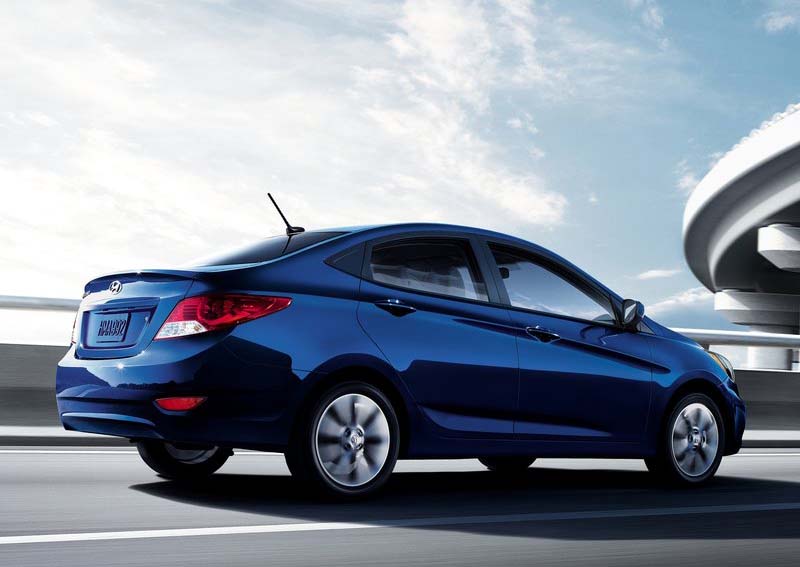
Hyundai Accent, 2012


  •  Hyundai Accent, 2012
The Hyundai Motor America introduced the all-new 2012 Hyundai Accent with best-in-class standard fuel economy and power at the 2011 New York International Auto Show. This marks the U.S. debut of the latest version of the popular subcompact sedan and the new top-of-the line, more functional Hyundai Accent five-door.

Hyundai Accent redefines expectations in the subcompact category by offering the company's distinctive and upscale "Fluidic Sculpture" design, best-in-class standard fuel economy, exceptional roominess and a full complement of standard safety features. Despite surprising technology and a significant increase in safety features, Hyundai will hold the line on pricing from the prior generation to continue delivering unmistakable value to customers.

"The 2012 Hyundai Accent reinvigorates the subcompact segment, similar to what the game-changing Sonata and Elantra have done in their categories," said Mike O'Brien, vice president, Product and Corporate Planning, Hyundai Motor America. "Accent's class-leading standard fuel economy is another showcase of Hyundai's dedication to improving fuel efficiency with advancements to traditional gasoline powered vehicles and is the fourth nameplate in Hyundai's lineup delivering 40 mpg on the highway."

ADVANCED TECHNOLOGY FOR SUPERIOR FUEL ECONOMY
The 2012 Hyundai Accent's all-aluminum 1.6-liter Gamma four-cylinder engine utilizes the latest engine technology to deliver a class-leading 138 horsepower and 123 lb-ft of torque and a best-in-class standard 30 mpg city and 40 mpg highway fuel economy rating.

The engine's most notable feature is its use of GDI, a first for the subcompact category. By precisely controlling the injection of fuel, GDI allows for better fuel economy, increased power and reduced emissions. The application of Dual Continuously Variable Valve Timing (D-CVVT) on both intake and exhaust camshafts allows for increased efficiency, improved fuel economy and reduced emissions. Other elements resulting in reduced fuel consumption include an Alternator Management System, an offset crankshaft design, variable induction system and electronic throttle control. To reduce lifetime operation costs and increase reliability, the Gamma features a maintenance-free silent roller timing chain. The Gamma also uses innovative anti-friction coatings such as CrN Physical Vapor Deposition (PVD) coating and Diamond Like Carbon (DLC) coating.

Several other systems have been improved over the outgoing model, each contributing to increased fuel efficiency. The 2012 Hyundai Accent can be equipped with a six-speed manual or automatic transaxle with SHIFTRONIC manual control, delivering smooth and efficient power delivery. Low-rolling resistance silica tires and a slippery shape (0.30 cd) reduce friction with the road and the air. This aerodynamic shape also includes a kicked up trunk edge, wheel arches which shield the tires and an optimized engine undercover. Finally, the ActiveECO function modifies engine and transmission control to smooth out throttle response. By turning on the ActiveECO function, drivers can realize up to a seven percent increase in real-world fuel economy.

Despite the additional content, safety features and technology packed into the all-new Hyundai Accent, Hyundai has avoided the typically associated penalty of increased weight. A low curb weight corresponds to an improvement not only in fuel economy but all other dynamic areas. In fact, Hyundai Accent offers the best power-to-weight ratio in its class by far, providing drivers with both low fuel consumption and responsive performance. Highlights which contribute to a low curb weight include the 1.6-liter Gamma GDI engine with aluminum block that is more powerful and 40 lbs lighter than the outgoing 1.6-liter Alpha engine, monotube shock absorbers, integrated parking brake and a super flat torque converter.

40 MPG - AN 18 PERCENT IMPROVEMENT IN FUEL ECONOMY
The 2012 Hyundai Accent's highway fuel economy of 40 mpg is an 18 percent improvement over its predecessor's 34 mpg highway manual transmission fuel economy rating.

Hyundai Accent's fuel economy is 30 mpg city and 40 mpg highway, with the six-speed automatic transmission or manual transmission. These figures give Hyundai Accent a highway-only driving range of up to 456 miles.

SAFETY
Hyundai doesn't believe consumers should have to pay a premium for safety, so a long list of safety features is included as standard equipment on all 2012 Accent models. A total of six airbags protect occupants in the event of a collision, including two front impact airbags, two front seat-mounted side impact airbags, and curtain side-impact airbags for front and rear passengers. Hyundai Accent's new standard front-seat active head restraints help prevent whiplash by automatically reducing the space between a front occupant's head and the head restraint during certain rear collisions and are highly recommended by safety organizations such as the Insurance Institute for Highway Safety (IIHS). Active front head restraints are not available on Fiesta, Yaris, Aveo or Mazda2.

The Hyundai Accent's underlying structure is engineered to protect occupants using a Collision Load Dispersion mechanism and the rear doors have internal beams. The vehicle's structure distributes the force of an impact in three ways to minimize floor deformation and maintain the integrity of the cabin.

Electronic Stability Control (ESC) and Traction Control work together to help deliver confident handling in all conditions. Vehicle Stability Management (VSM) integrates control of the ESC and motor-driven power steering (MDPS) to provide handling assistance in slippery conditions or in sudden cornering scenarios. The system can deliver up to eight Newton-meters of counter-steering effort when required to assist the driver in maintaining control of the vehicle.

A key safety element for any vehicle is its braking system. Hyundai Accent is the only car in the subcompact segment to offer four wheel disc brakes as standard equipment. An Anti-lock Braking System (ABS) featuring Electronic Brake Force Distribution (EBD) and Brake Assist (BA) is also included. EBD examines the effect of vehicle load on weight distribution and apportions the braking force between front and rear axles to maximize stopping ability. In the event of a panic stop, BA ensures that maximum braking force is applied.

SMALL ON THE OUTSIDE, BIG ON THE INSIDE
All Accents ride on a 101.2 inch wheelbase, 2.8-inches longer than the previous generation. The 66.9-inch width on all 2011 models increased by 0.2 inches for 2012. The Hyundai Accent 4-door's overall length has increased by 3.5 inches to 172 inches. Total length of the new five-door version is 162 inches. As a result, Accent enjoys superior interior volume and passenger space. While the car's exterior dimensions are consistent with those of traditional subcompacts, Hyundai Accent is classified by the EPA as a compact sedan thanks to its interior volume. Toyota Yaris and Ford Fiesta are classified as subcompact cars. In addition the Hyundai Accent five-door has best-in-class cargo volume and more cargo capacity than the Nissan Juke and Infiniti EX 35 crossover. The Accent has best-in-class front and rear shoulder room and the five-door also has more cargo volume than many of its compact five-door competitors.

CONFIDENT DRIVING DYNAMICS
The first step toward confident driving dynamics is a rigid structure. To this end, the 2012 Hyundai Accent employs high-tensile strength steel to deliver a strong, light and stiff body which is 22 percent stiffer than the previous generation. Increasing the stiffness of the structure allowed Hyundai engineers more flexibility in terms of suspension tuning. The end result is a better balance between handling precision and ride comfort. Accent employs a MacPherson strut front suspension with coil springs and twin-tube gas shock absorbers. The rear suspension is a torsion axle setup with coil springs and monotube shock absorbers.

All Accents have column-mounted, motor-driven electric power steering that adjusts instantly to changing driving conditions while improving fuel economy over a conventional steering system. Hyundai Accent's turning diameter of 34.1 feet is better than Versa, Fiesta and Fit. The SE five-door model has a unique steering calibration for a sportier feel.

FLUIDIC SCULPTURE DESIGN
The 2012 Hyundai Accent joins the Hyundai line-up sporting the company's increasingly popular "Fluidic Sculpture" design. The vehicle's exterior lines are intended to be futuristic, dynamic, and sleek. In a segment typically associated with staid designs, Accent stands out from the crowd. While the styling provides an attractive form, it's also functional, featuring a slippery 0.30 coefficient of drag for Hyundai Accent sedan and .31 for Accent five-door. Hyundai's signature hexagonal front grille and detailed swept-back headlights give Accent a compact athletic face. Five-door SE models include a sporty roof-mounted spoiler and vertical taillights. For an assertive stance, 16-inch alloy wheels are available on GLS and standard on SE.

COLOR PALETTE
The 2012 Hyundai Accent GLS is available with gray or beige two-tone interior. The five-door GS and SE trims are available with a gray interior or a monotone black interior. All Accents have cloth-like pillar trim made of fibrous tissue and volcanic rock for a premium look and feel.

The Hyundai Accent features a bold exterior color palette with both light and dark colors including Century White, Ironman Silver, Cyclone Gray, Ultra Black, Boston Red, Mocha Bronze, Marathon Blue, Clearwater Blue and Electrolyte Green.

FEATURES AND AMENITIES WORTHY OF MORE EXPENSIVE CARS
Choosing a subcompact sedan no longer means foregoing comfort and convenience features. The 2012 Accent will be offered in three trim levels. The affordable four-door GLS, the versatile, well equipped five-door GS and the sporty five-door SE. The entry level Hyundai Accent three-door has been discontinued for the 2012 model year.

Friday, October 7, 2011

Hyundai Blue2 Concept, 2011


Hyundai Blue2 Concept, 2011

The premiere of the Hyundai Blue2 concept car (codenamed HND-6), a mid-size FCEV which shows a blueprint for future sedans. The name 'Blue2' is a combination of Hyundai's sub eco-brand 'Blue Drive' and the number `2' from H2, the symbol for hydrogen gas.

The, Hyundai Blue2 concept is powered by a fuel cell electric system that delivers a stack power of 90kW (1.65kW/L) and fuel economy of 34.9km/l. The Blue2 is materialized in a sporty and luxurious style, a combination of futuristic, flowing designs and eco-friendly features. The Hyundai Blue2 concept is equipped with low-resistance tires and alloy wheels which are designed to improve aerodynamic performance, while the car's interior design encompasses a futuristic look by using eco-friendly new materials.

Hyundai's concept keywords for the exterior design are 'Intersected Flow,' featuring innovative and dynamic designs. The vehicle's condition is visible via unique and futuristic images on the exterior of the car through outside LED screen panels, which are located on both the front and rear of the car. Blue2 also features a welcome system which recognizes the driver, while an automatic opening door system enhances the driver's convenience. Conventional side mirrors are replaced by side cameras and a roof camera, offering a state-of-the-art driving environment.

The exterior designs flow inside the vehicle, with asymmetrically-designed dashboards and doors to optimize a driver's convenience and add emotional value. Wider seats enable people to get in and out of the vehicle more comfortably.

The Hyundai combined the cluster and center fascia, applying an advanced Transparent Organic Light Emitting Diode (TOLED) monitor and ultra-light tempered glass, called Gorilla Glass, providing more accurate and vivid graphic information. The infotainment system is operated by a Motion Sensor Moustick, a haptic wheel and motion sensor that respond to the driver's touch and hand movements, respectively, giving drivers a new experience.

The Hyundai Blue2 concept aims to satisfy all the senses of future drivers, including the air they breathe: A cluster ionizer freshens the air inside the vehicle, while antibacterial genuine leather with leaf-shaped patterns, called 'eco-graphic perforation,' enhances an eco-friendly look and feel.

Hyundai Curb Concept, 2011


Hyundai Curb Concept, 2011

POTHOLES AND NIGHTCLUBS
The inspiration for Hyundai Curb Concept came from the need to evolve Hyundai's "Fluidic Sculpture" design language for younger buyers. Hyundai designers wanted to create a vehicle loaded with technology that was at home in an urban environment with potholes and densely packed nightclubs on the streets. The vehicle needed to secure the advanced Blue Link and connectivity features against impact and shock. From these ideas, the 'technology rugged' design direction for Curb was formed.

EXTERIOR DESIGN
The Hyundai Curb Concept's design starts with the glass that spills into the hood and wraps around the cowl, covering the A pillars. This look resembles the face shield of a sport bike motorcycle helmet. Beneath the glass are structural trusses with the glass panels applied like a shield.
The striking profile is dominated by a boomerang trajectory body side line. This dominant line brings the entire design together and reinforces the feeling of strength with its positive and negative shapes.

The thin, sleek headlamps and tail lamps dive into the vehicle, creating the illusion that they are connected into the engine compartment or interior. To complete the 'technology rugged' look, designers added 22-inch five spoke wheels and Michelin tires with a custom saffron colored tread pattern to match the interior. These wheels have spokes set into the tires to make them have a more pronounced profile. To enter the Hyundai Curb Concept, one simply drags their finger across a touch pad to open the doors.

The exhaust vents serve a dual purpose. They pop out to reveal a bike rack so the owner could park and ride a "Fixie" (fixed gear) bike to the rest of his destinations as an alternative transportation source. The roof also features pop-up roof rack towers, demonstrating the perfect blend of being rugged, yet high-tech. Curb has a lighted clam shell rear hatch, also opened via a touchpad for loading gear and a third rear access door for easy passenger ingress and egress.

At start up, the Hyundai Curb Concept's numerous LED lights illuminate sequentially, starting with the outside rows and the Curb's badging illuminates through the paint. Shamze Custom Coatings developed the One-Way paint finish allowing the Curb name to illuminate through the paint.

EMPOWERED CONNECTIVITY
Connectivity is the theme for the interior, which is why information flows seamlessly from outside to inside of the Hyundai Curb Concept.

A large acrylic screen with multiple zones allows information to be passed between passengers all via a touchscreen that appears endless. It flows like a river from the gauge cluster to the center stack controls, across the instrument panel and all the way into back seat. The steering wheel itself is an opaque surface with a monitor showing through. There are also monitors in the back of the headrests. A Heads Up Display (HUD) provided by Continental with navigation keeps the drivers eyes on the road, while passengers search for their favorite channel on Pandora. Drivers are able to navigate their music via a 3-D carousel of album cover art as well as view the related cover art for a currently playing track. Cameras also replace the side mirrors and are linked to the HUD. The screen can also display vehicle diagnostics, download apps and act as a video phone all with a single touch sensor control strip provided by Methode.

The inside of Hyundai Curb Concept designers had the rocker panels flow into the interior of the vehicle to create a seamless design. The Curb links its interior and exterior designs together by having the rocker panels viewable from the exterior flow into the interior. The three-holed open truss structured A-pillars enhance the driver's cornering visibility, structurally support the roof and are made from a single milled piece. This metal structure connects everything together.

Saffron accents inside match the ones on the tires. The saffron accents appear as a gradient pattern on the seats, which are made of super-stretch, fast-drying board short material. The rear seat also has forward and aft movement.

When it comes to storage capacity, Hyundai Curb Concept has rear head rests mounted to its robust frame, rather than to the seats. These head rests swivel up into the roof, allowing the rear seats to fold flat.

HYUNDAI BLUE LINK TECHNOLOGY
The inside, a driver could be listening to their favorite station on Pandora, cruising the city and get a phone call from a friend. Using Blue Link, the caller's location shows up as a Point-of-Interest (POI). The friend tells the driver that he just discovered a great band playing at a local club and invites him to come. His location then becomes the destination for the turn-by-turn directions.

1.6-LITER GAMMA POWERTRAIN
The Curb is powered by a turbocharged 1.6-liter Gasoline Direct Injection (GDI) four-cylinder engine mated to Direct Shift Gearbox (DSG). This powertrain develops 175 horsepower and 169 lb. ft. of torque. By adding Idle Stop and Go (ISG) technology, the Hyundai Curb Concept would deliver 30+ miles per gallon in the city and 40+ miles per gallon on the highway.

Hyundai

Hyundai
= Hyundai Blue2 Concept
= Hyundai Curb Concept
Related Posts Plugin for WordPress, Blogger...